Extract from a novel- analysing
- aspects of MLE the use of 'h' dropping from the cockney accent as shown through the variation of "ello"
- aspects of jamiacian creole- dropping "th" and replacing it with a "d" for example "dat"
-"den"- dental fricative replaced for the aveolor plosive
-aspects of MLE- dont pronouce the last constant - "nuthin"
-use of slang expressions - "ravin". and "screwin"
Thursday, 12 December 2013

Thursday, 28 November 2013
Global English- Australian English
Australian English variations
Phonetics
pronounce "oe" for example in "shoe" as a longer "u"
pronounce "ould" as "u" for example "should"
make "a" in words such as "cart" longer
"ai" in "air with a longer "e" sound
"u" in but as "a"
"a" in "bat" with a longer "a"
Lexical
Australian English Standard English
ace- good/excellent
aggro - aggressive
arvo- good afternoon
bang- sexual intercourse
beaut- great/fantastic
big bickies- lots of money
bizzo- business
your blood's worth bottling- you are excellent/good
blow- to have a rest (especially after physical work)
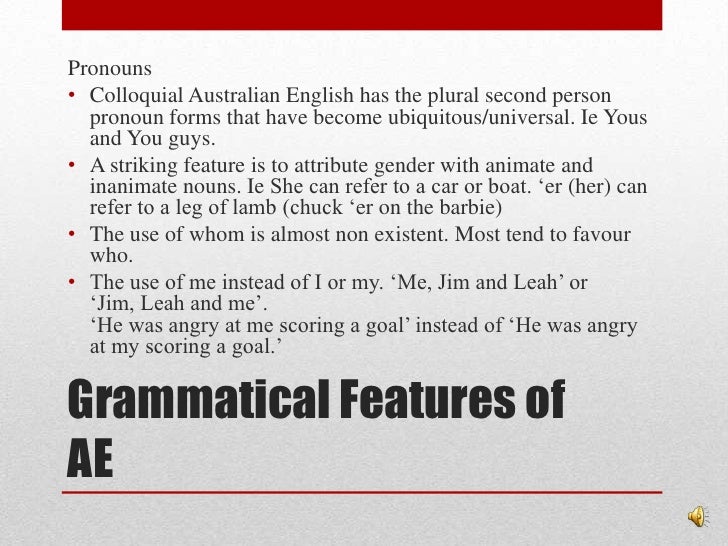
Grammatical
the use of "don't" instead of doesn't - "he don't wanna go"
the use of double negatives- "I never did nothing"
The use of NEVER a general negative in replace of the auxiliary NOT

Phonetics
pronounce "oe" for example in "shoe" as a longer "u"
pronounce "ould" as "u" for example "should"
make "a" in words such as "cart" longer
"ai" in "air with a longer "e" sound
"u" in but as "a"
"a" in "bat" with a longer "a"
Lexical
Australian English Standard English
ace- good/excellent
aggro - aggressive
arvo- good afternoon
bang- sexual intercourse
beaut- great/fantastic
big bickies- lots of money
bizzo- business
your blood's worth bottling- you are excellent/good
blow- to have a rest (especially after physical work)
Grammatical
the use of "don't" instead of doesn't - "he don't wanna go"
the use of double negatives- "I never did nothing"
The use of NEVER a general negative in replace of the auxiliary NOT
Tuesday, 29 October 2013
investigation: transcript 2
Yasmin Banner
Transcript 2: Sam and
Joey break up- joey goes round to Sam’s house whilst they are on holiday
Joey: alright
Sam: Hello, you ok?
Joey: yeah
Sam: come in
[…]
Sam: you ok?
Joey: yeah you?
[.]
Sam: fine, I’m just so
disappointed and upset that we haven’t spent any time together this holiday [.]
Joey: what did I say the first four
days of the holiday, I wanted to try and see you. And you, you were just going
out
Sam: you can’t say that, because I’ve
only had one big night out and you’ve
had one big night out
Joey: you’re lying to me again
Sam: it’s not just about this holiday,
since the engagement all we’re doing is arguing. We need to sort it out. Because
the last thing I want to happening…
Joey [interrupts]- we can’t
sort it, you need to be honest with me Sam
Sam: I am being being honest with
you
Joey [Interrupts]: YOURE ENT, YOU WENT TO A BOYS HOUSE PARTY DON’T LIE…
Sam [ interrupts]-
NO I DIDN’T!
…YOU DID, YOURE
LYING TO ME
Sam: oh my god
[…] (Joey
crying)
Joey: you ent
being straight with me Sam
Sam: what do
you think I’ve done?
Joey: NOTHING, YOUVE
JUST BEEN GOING OUT PARTYING WITH BOYS AND AND YOU AINT EVEN SAID…YOURE TRYING
TO SAY YOU AINT
Sam:
alright ok, its all me
Joey: it aint all you sam but
you’ve…
Sam [interrupts]- yeah, so pathetic
…but this holiday you haven’t treated me with respect
Sam: I am treating you with respect
Joey: YOU HAVENT
Sam: I don’t understand why you’re getting so upset
Joey: because you’re lying, you’re breaking my heart sam. You
shouldn’t be doing that
[..]
Joey: you aint being honest with me [.] you aint
Sam: there’s nothing to be honest about
Joey: it’s about the whole thing, about the ringing thing. I’ve
been ringing you the whole holiday [.] You haven’t said sorry Sam
Sam: well I’m sorry
Joey: you’ve been on this holiday like a single lady
Sam: so
have you and the boys
Joey: I haven’t, I haven’t. Sam no I have not
Sam: ONE MAD NIGHT IVE HAD, THE REST OF THE TIME IVE GONE
FOR DINNER AND COME BACK HOME
Joey: I’m always upset because you always…
Sam: so am I, I’m always upset you don’t even see half of it [clash]
Joey: you are upset…but I’m a lot more, because you’re a lot
more vicious than me Sam and a lot more angry than me
Sam [interrupts]-
vicious? More like I’m a lot more grown up than you Joe
[.]
Joe: it’s just not working, you’re not its its not right, it’s
not healthy is it?
Sam: but we’re going to have arguments Joe, all couples
argue. You’ve been in a relationship before to know that couples argue. If we didn’t
argue that’s unhealthy.
Joe: you are the love of my life Sam, a lot of people know
that, you know that
investigation: the 1st transcript and the question
Investigation 1st
transcript and question
Transcript one: investigation into
females and males in a stressful relationship situation (based on data
collected from the reality television show “ the only way is Essex)”
[.]- short pause
[..]- longer pause
Joey: alright
Sam : hi [.]
How are you?
Joey: yeah I’m alright, are you alright?
Sam: good [.]
Joey: you look nice
Sam: thank you
Joey: nice and green [clash]
Sam:
and you in your short hot pants
Joey: {laughs}
Sam:
Is that your new look
Joey: yeah
Sam: exchanged
from skinny jeans to hot pants
Joey: yeah exchanged, na I still wear them [.]
Erm … yeah so. basically I…I wanted to ask you, I don’t understand
why d’you…why did you split up with me. Wha, what was the main reason. what I don’t
know why you did it
Sam: I don’t know really it was just one of those
situations where we got together really quickly and don’t get me wrong I did, I
do still really like you[.] and, I dunno I just felt like it wasn’t the right
time [..]
Joey: yeah I know what you mean[.]
I think we did, I think what your trying to say is we did
too much in the space of like 2 to 4 months, sort of thing
Sam: yeah [..] yeah it was like, like a bit of a
whirlwind , do you know what I mean?
Joey: yeah,yeah,yeah
Sam: but do get me wrong, I was completely
wrong to ring you up and say to you “aw I feel like [.] we need to have a break”
and stuff like that. Cuz that was really out of order. But it wasn’t one of
those situations I have been thinking about for ages like, like I wouldn’t do
that, I wouldn’t…
Joey [interrupt]:The
only thing, only thing that was just so weird like you acted so normal throughout,
throughout all that. That morning when I woke up in bed and like said see you
later and all that do you know what I mean and all that. You acted completely
normal and then you left, you didn’t even lead up to it or anything, you just
sort of like bang. That why, that’s why it was such a big shock. I didn’t expect
it thats why I was upset.
Sam: I did say, when is aid it on the phone, like I did
feel really bad but then I did say to you like lets meet up when I get back and
we can talk about it and you didn’t want to. I can understand that but you didn’t
want to
Joey: why would I want to talk about it? If you just,
it would be like me going, that’s it aw youre dumped [.] oh can I see you
tomorrow, forget I said that
Sam: yeah but I didn’t say it like that
Joey: you pretty much, yeah you didn’t say it like that. But that’s pretty
much. That’s that’s, cut a long story short. That’s what you did, you ended it
with me and then said aw actually forget I said anything see you tomorrow. That’s
why I was like, aw why do I want to see you tomorrow ouve already split up with
me.
Sam: it wasn’t easy […]
Joey: I know, I know that… its just a bit upsetting for me
Tuesday, 15 October 2013
John Agard - Mr Oxford Don
A2 English Language
John Agard - Mr Oxford Don
"me not no oxford don"- instead of using the present possessive, personal pronoun of "my" he replaces it with the 1st person object pronoun of "me". this is frequent in Jamaican creole, it maybe that English and Jamaican were languages were forced to communicate therefore have got confused with the English grammar, therefore has become common in Jamaican creole. As when people that speak Jamaican creole may pass it down to their children and then carries on as a language.
"Mr oxford Don"- "don" is Jamaican lexis for a boss or someone in higher position than yourself. It is now also used in Multicultural language (this is a mixture of dialect from standard English, Asian and Jamaican, it is very frequent in the eastern parts of London as shown through the media)
what is he trying to say
" a man on the run is a dangerous one" as he is speaking in a Jamaican accent, he is emphasising that "oxford don" accuses Jamaican people of being dangerous as they have came from a different country. He might be saying this because of their accents in which is shown throughout this poem. "I didn't graduate, I immigrate" this shows he is trying to say that just because he didn't graduate from school, it doesn't mean he is not educated. he has just immigrated from another country.
John Agard - Mr Oxford Don
"me not no oxford don"- instead of using the present possessive, personal pronoun of "my" he replaces it with the 1st person object pronoun of "me". this is frequent in Jamaican creole, it maybe that English and Jamaican were languages were forced to communicate therefore have got confused with the English grammar, therefore has become common in Jamaican creole. As when people that speak Jamaican creole may pass it down to their children and then carries on as a language.
"Mr oxford Don"- "don" is Jamaican lexis for a boss or someone in higher position than yourself. It is now also used in Multicultural language (this is a mixture of dialect from standard English, Asian and Jamaican, it is very frequent in the eastern parts of London as shown through the media)
what is he trying to say
" a man on the run is a dangerous one" as he is speaking in a Jamaican accent, he is emphasising that "oxford don" accuses Jamaican people of being dangerous as they have came from a different country. He might be saying this because of their accents in which is shown throughout this poem. "I didn't graduate, I immigrate" this shows he is trying to say that just because he didn't graduate from school, it doesn't mean he is not educated. he has just immigrated from another country.
Voices poll
Yasmin
A2 English Language
Voices poll
.
Participants were asked to rank celebrities in order of how pleasant their voices sound.
Suave Scot Sean Connery swept the board, bowling people over with his dulcet Edinburgh tones. Throughout the UK, his voice was consistently voted the most pleasant in the BBC-commissioned poll.
Fellow Bond actor Pierce Brosnan - who was born in the Republic of Ireland, raised in England and has lived in the USA for over 20 years - was also high up the list. More popular, however, were newsreaders Moira Stewart and Trinidad-born Trevor McDonald. Sir Trevor's appealingly authoritative voice put him in second place overall.
Northern Irish participants were the only group who found Ian Paisley's voice acceptable - his was voted 'least pleasant' by all other areas of the UK. In Northern Ireland, Janet Street-Porter's Estuary tongue was declared least attractive, and she fared little better among Scottish and Welsh voters.
It was a red card for David Beckham too, while Billy Connolly, Cilla Black and Paul O'Grady were also given the thumbs down
Aim- to find out how people fee4l about accents and languages across the British isles Methodology- in the online poll 5000 people took part in the aim. however the final sample showed 5010 that completed the survey the age of 15+. the ratio was a 49-51 ratio
findings and analysis- the survey showed that some people liked their accents but the majority wanted to change their accents especially for older people and in meetings. the Edinburgh accent turned out to be very popular for people to like, where as the cockney accent was not as popular.
Our respondents are a dissatisfied bunch: 59% of them wish at least occasionally that they had a different accent. This rises to a massive two thirds in Northern Ireland. The most wished-for accent is a Standard English accent, but 7% said they would rather have a Southern Irish accent (12% in Northern Ireland).
conclusions- over people have both positive and negative attitudes towards different accents. some people enjoy hearing their own and other accents, where as others don't like their accent and feel its hard to find jobs with it. although some people feel having their accent helps to get jobs.
Evaluation- the study is representative of the wider population because there is a wide sample size making the study reliable. however it is not valid as they are peoples opinions and could effevt what celebrities or kind of people they like
A2 English Language
Voices poll
.
Participants were asked to rank celebrities in order of how pleasant their voices sound.
Suave Scot Sean Connery swept the board, bowling people over with his dulcet Edinburgh tones. Throughout the UK, his voice was consistently voted the most pleasant in the BBC-commissioned poll.
Fellow Bond actor Pierce Brosnan - who was born in the Republic of Ireland, raised in England and has lived in the USA for over 20 years - was also high up the list. More popular, however, were newsreaders Moira Stewart and Trinidad-born Trevor McDonald. Sir Trevor's appealingly authoritative voice put him in second place overall.
Participants were asked to rank celebrities in order of how pleasant their voices sound
Respondents indicated a preference for accents relatively local to them: Scots said they loved Ewan McGregor's Perthshire accent, the English found Hugh Grant's voice attractive, people in Wales preferred listening to Welsh actor Richard Burton and newsreader Huw Edwards, while those in Northern Ireland found Terry Wogan's Limerick accent irresistible.Northern Irish participants were the only group who found Ian Paisley's voice acceptable - his was voted 'least pleasant' by all other areas of the UK. In Northern Ireland, Janet Street-Porter's Estuary tongue was declared least attractive, and she fared little better among Scottish and Welsh voters.
It was a red card for David Beckham too, while Billy Connolly, Cilla Black and Paul O'Grady were also given the thumbs down
Aim- to find out how people fee4l about accents and languages across the British isles Methodology- in the online poll 5000 people took part in the aim. however the final sample showed 5010 that completed the survey the age of 15+. the ratio was a 49-51 ratio
findings and analysis- the survey showed that some people liked their accents but the majority wanted to change their accents especially for older people and in meetings. the Edinburgh accent turned out to be very popular for people to like, where as the cockney accent was not as popular.
Our respondents are a dissatisfied bunch: 59% of them wish at least occasionally that they had a different accent. This rises to a massive two thirds in Northern Ireland. The most wished-for accent is a Standard English accent, but 7% said they would rather have a Southern Irish accent (12% in Northern Ireland).
conclusions- over people have both positive and negative attitudes towards different accents. some people enjoy hearing their own and other accents, where as others don't like their accent and feel its hard to find jobs with it. although some people feel having their accent helps to get jobs.
Evaluation- the study is representative of the wider population because there is a wide sample size making the study reliable. however it is not valid as they are peoples opinions and could effevt what celebrities or kind of people they like
Rasta mouse - controversy
Rasta mouse - controversy
http://www.telegraph.co.uk/culture/tvandradio/bbc/8320549/Rastamouse-provokes-complaints-of-racism-and-teaching-bad-language.html
1) How is the language issue represented?
the language issue is represented in a negative and in a derogative way, parents especially feel its racist and slang. the fact that they see Jamaican creole as slang shows they people do not view it as a language, and are not proud for their children to be able to speak it.
2) how does the author represent himself and others?
the author represents himself as a positive supporter of Rasta mouse to some extent as he expresses the views of experts such as "a BBC spokesman" that are supportive of the text. however the structure of the article shows tat the author may also feel the text is racist and encourages children to use "slang" as he expresses the thoughts of mothers first. the author represents the opinions of the parents as negative and concerned with what people think of their children and the fact that they are not suppose to speak Jamaican creole if they are white.
3) how do they shape the readers response?
the author shapes the readers response to be negative as they use figures such as: "The BBC has received complaints from six viewers that the animated show stereotypes black people, while another 95 have complained about the language used in the show.", due to a appeal to popularity people who read the article may feel that they should think the same thing because the majority feel the text is racist and slang.
http://www.telegraph.co.uk/culture/tvandradio/bbc/8320549/Rastamouse-provokes-complaints-of-racism-and-teaching-bad-language.html
1) How is the language issue represented?
the language issue is represented in a negative and in a derogative way, parents especially feel its racist and slang. the fact that they see Jamaican creole as slang shows they people do not view it as a language, and are not proud for their children to be able to speak it.
2) how does the author represent himself and others?
the author represents himself as a positive supporter of Rasta mouse to some extent as he expresses the views of experts such as "a BBC spokesman" that are supportive of the text. however the structure of the article shows tat the author may also feel the text is racist and encourages children to use "slang" as he expresses the thoughts of mothers first. the author represents the opinions of the parents as negative and concerned with what people think of their children and the fact that they are not suppose to speak Jamaican creole if they are white.
3) how do they shape the readers response?
the author shapes the readers response to be negative as they use figures such as: "The BBC has received complaints from six viewers that the animated show stereotypes black people, while another 95 have complained about the language used in the show.", due to a appeal to popularity people who read the article may feel that they should think the same thing because the majority feel the text is racist and slang.
Prescriptivism and Descriptivism
Prescriptivism and Descriptivism
Definitions
Based on my research prescriptivism is a view where some people feel a language is inherently superior to others. they believe that this more highly valued variety should be imposed on the whole of a particular speech community.
where as Descriptivism is the view that the assignment of a superior status to one variety of language is often arbitrary and is more likely to be the result of socio-economic factors than of intrinic linguistic factors.
John Simon- critic- well known prescriptivist
John Simon was named the "the prince of prescriptivism"
He quoted: “Why Good English Is Good For You.” - though I could not find what he felt about non standard English, this shows he felt standard English was the right and good way to speak, and that it is better for you. this may show he felt it was correct to speak in this manner, where as non standard English was not good because it wasn't good for you.
Samuel Johnson - Descriptivist
some writers argue that linguistic prescription is foolish or futile. Samuel Johnson, commented on the tendency of some prescription to resist language change:
Johnson felt language was always changing, when people die new generations come in forming new lexis and phrases, language is always evolving. he felt that people who want to maintain the English language are just resisting change.
Definitions
Based on my research prescriptivism is a view where some people feel a language is inherently superior to others. they believe that this more highly valued variety should be imposed on the whole of a particular speech community.
where as Descriptivism is the view that the assignment of a superior status to one variety of language is often arbitrary and is more likely to be the result of socio-economic factors than of intrinic linguistic factors.
John Simon- critic- well known prescriptivist
John Simon was named the "the prince of prescriptivism"
He quoted: “Why Good English Is Good For You.” - though I could not find what he felt about non standard English, this shows he felt standard English was the right and good way to speak, and that it is better for you. this may show he felt it was correct to speak in this manner, where as non standard English was not good because it wasn't good for you.
Samuel Johnson - Descriptivist
some writers argue that linguistic prescription is foolish or futile. Samuel Johnson, commented on the tendency of some prescription to resist language change:
When we see men grow old and die at a certain time one after another, from century to century, we laugh at the elixir that promises to prolong life to a thousand years; and with equal justice may the lexicographer be derided, who being able to produce no example of a nation that has preserved their words and phrases from mutability, shall imagine that his dictionary can embalm his language, and secure it from corruption and decay, that it is in his power to change sublunary nature, and clear the world at once from folly, vanity, and affectation
Johnson felt language was always changing, when people die new generations come in forming new lexis and phrases, language is always evolving. he felt that people who want to maintain the English language are just resisting change.
Subscribe to:
Posts (Atom)